
Introduction
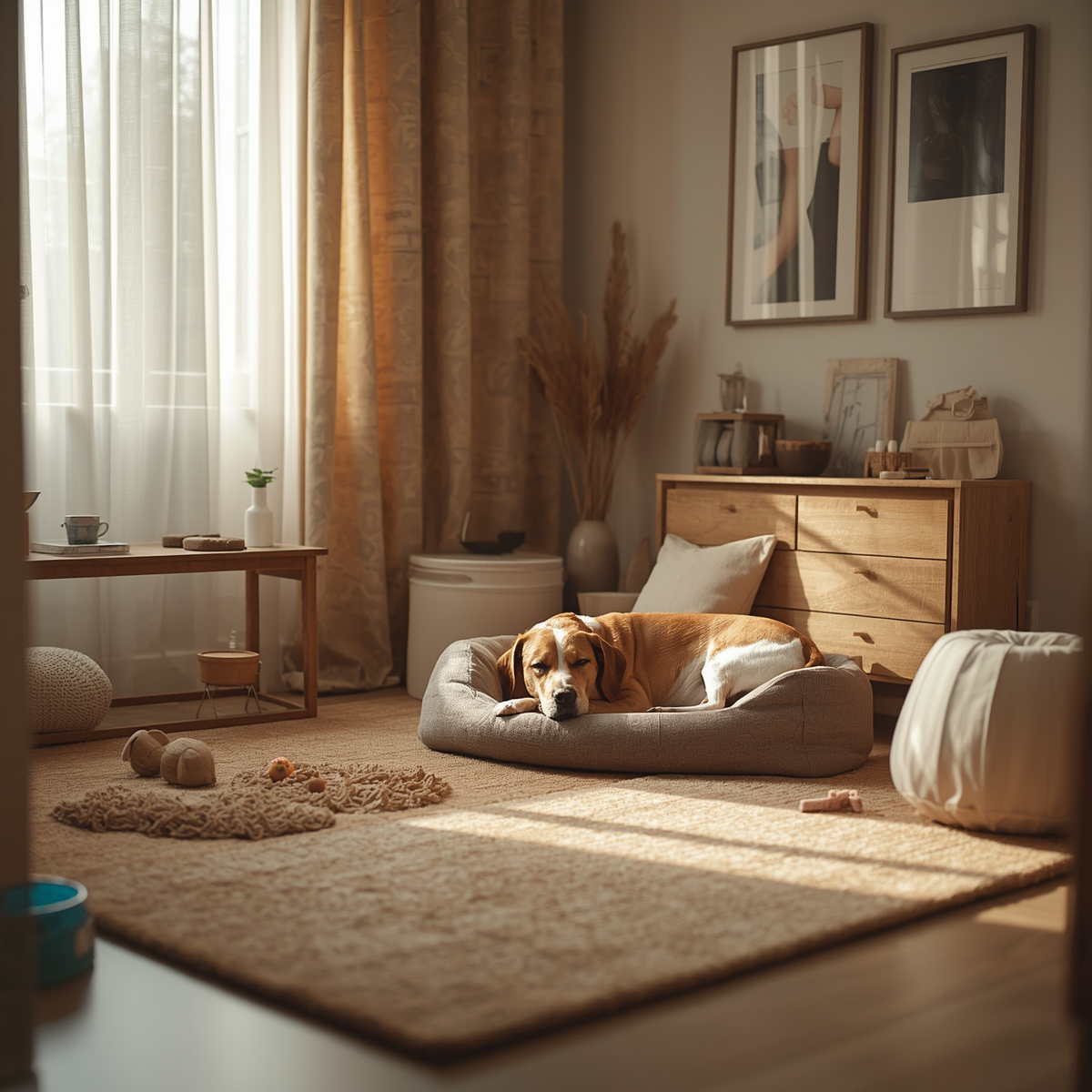
Your home should be one of the places where your dog feels safest.
But sometimes, even a comfortable house can be surprisingly stressful for a dog.
Constant noise, unpredictable activity, uncomfortable sleeping areas, too much stimulation, boredom, or simply not having a place to retreat can make it difficult for a dog to settle. Some dogs pace around the house. Others bark at every sound, follow their owners from room to room, become destructive, or seem unable to switch off.
The good news is that creating a calmer home usually doesn’t require a complete renovation or a house full of expensive dog products.
Small changes to your dog’s environment, routine, resting area, and daily stimulation can make a meaningful difference.
I’ve found that the biggest improvement often comes from thinking about the home from the dog’s perspective: Does my dog have somewhere comfortable to rest? Can they get away from activity when they want to? Do they know what to expect each day? Are they getting enough physical and mental stimulation?
This guide walks through how to help your dog relax at home and turn your house into a calmer, happier place for them.
Affiliate Disclosure
Some of the products recommended in this article may contain affiliate links. If you purchase through one of these links, TheDoggoLife may earn a commission at no additional cost to you. We only recommend products that we believe can provide a useful solution for dogs and their owners.
Table of Contents
- How to Help Your Dog Relax at Home
- Why Some Dogs Struggle to Relax
- Create a Dedicated Safe Space
- Give Your Dog a Comfortable Place to Sleep
- Reduce Noise and Household Stimulation
- Build a Predictable Routine
- Give Your Dog Enough Mental Stimulation
- Make Your Home Dog-Friendly Without Giving Up Your Style
- Calm Home vs. Overstimulating Home
- What Should You Change First?
- Real-Life Scenarios
- Mistakes to Avoid
- Tips for Maintaining a Calm Home
- Frequently Asked Questions
- Final Recommendation
1. How to Help Your Dog Relax at Home
The best way to help your dog relax at home is to create an environment that is comfortable, predictable, safe, and appropriately stimulating.
That means giving your dog:
- A dedicated place to rest
- A comfortable sleeping area
- A predictable daily routine
- Regular exercise
- Mental enrichment
- Opportunities to get away from household activity
- Reasonable control over noise and visual stimulation
- Clear boundaries
- Positive experiences in their favorite areas
You don’t need to make your entire house silent or turn one room into a dog-only zone.
Instead, think about creating a home where your dog has options.
They should be able to interact with the family when they want to, play when appropriate, and retreat somewhere comfortable when they need downtime.
That balance is what makes a home feel calmer.
2. Why Some Dogs Struggle to Relax
If your dog seems restless inside the house, it’s easy to assume they simply have too much energy.
Sometimes that’s true.
But restlessness can have several causes.
A dog may struggle to settle because they’re bored, overstimulated, uncomfortable, reacting to outside noises, adjusting to a new environment, or simply haven’t learned how to relax.
Young dogs are particularly prone to this.
Puppies can go from sleeping peacefully to running around the house in seconds. High-energy dogs may constantly look for something to do. Dogs that are sensitive to sounds may react whenever a car drives by, someone walks past the house, or a neighbor makes noise.
The first step is identifying what is keeping your dog from settling.
If the problem is boredom, more enrichment may help.
If the problem is excessive stimulation, creating a quieter retreat may be more useful.
If your dog is uncomfortable, improving their resting area should come first.
And if your dog’s behavior suddenly changes or appears severe, it’s worth discussing the situation with your veterinarian rather than assuming it’s simply a training issue.
3. Create a Dedicated Safe Space
One of the simplest ways to make your home calmer for your dog is to give them a place that is truly theirs.
This doesn’t have to be an entire room.
A quiet corner of the living room can work perfectly well.
The goal is to create an area where your dog can lie down without constantly being stepped over, interrupted, or surrounded by activity.
Depending on your dog and your home, this might include:
- A comfortable dog bed
- A crate
- A mat
- A blanket
- A favorite toy
- A water bowl nearby
- A baby gate or pet gate
- A covered or partially enclosed resting area
The important part is that the space should be associated with positive experiences.
Don’t use your dog’s safe space as punishment.
If your dog learns that going to their bed means they’re in trouble, it stops being a relaxing retreat.
Instead, let the area become somewhere your dog naturally wants to spend time.
For dogs that prefer privacy, an enclosed crate or covered resting area can be particularly useful.
For dogs that like to stay close to their owners, placing their bed in the main living area may work better.
The best location depends on the individual dog.
A Crate Can Give Your Dog a Quiet Place to Retreat
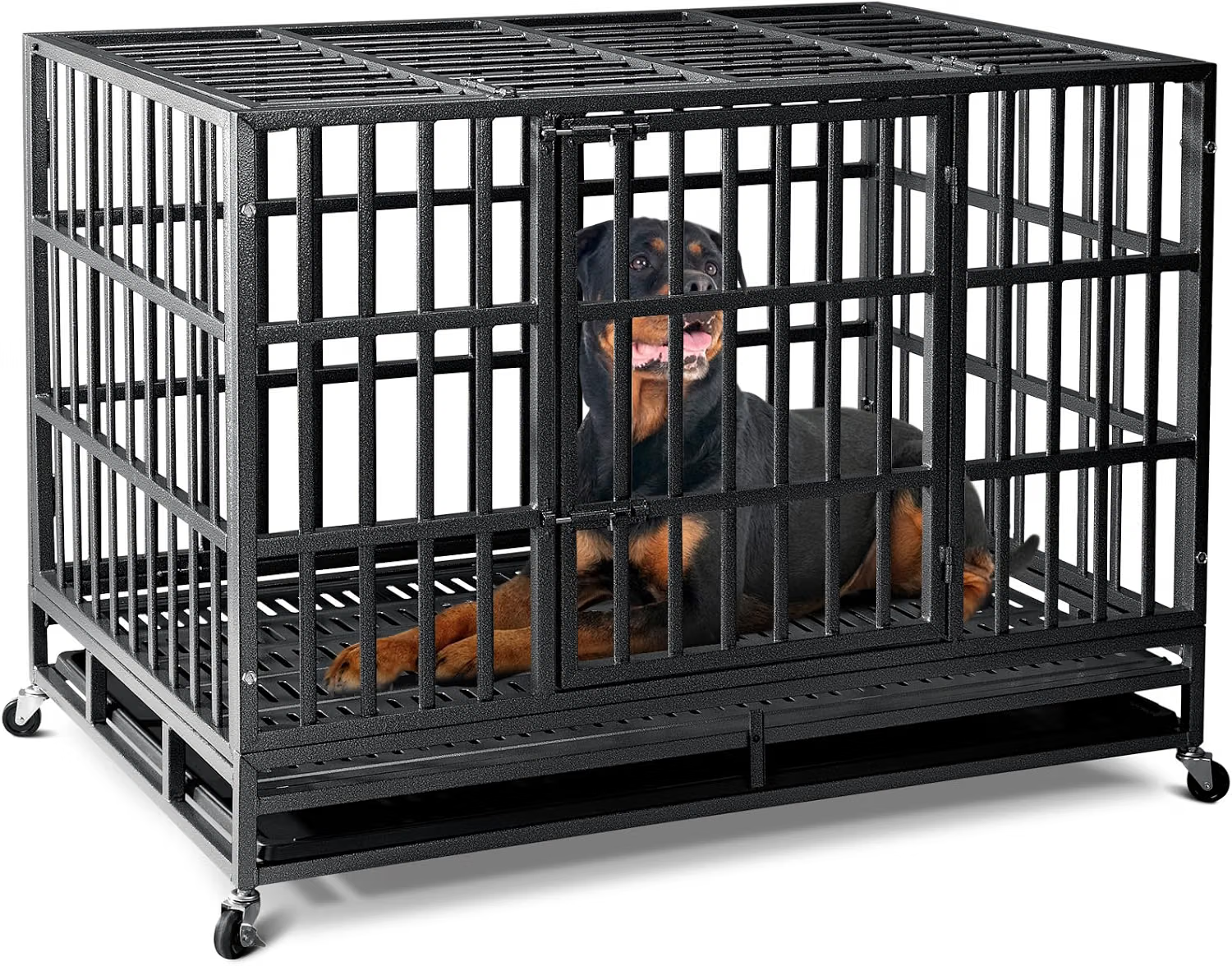
A properly sized crate can give your dog a consistent place to rest when they want some quiet time. The key is making the crate a positive, comfortable space rather than somewhere your dog is sent as punishment.
Why we like it: A crate can create a defined retreat without requiring a separate room in your home.
Pros:
- Creates a consistent personal space
- Works well in smaller homes
- Can be useful for rest and routine
- Available in many sizes and styles
Cons:
- Some dogs need gradual crate training
- Must be properly sized and introduced positively
- Not every dog prefers an enclosed resting space
Typical Price: $219.95
Affiliate Disclosure: This section may contain affiliate links. If you purchase through one of our links, TheDoggoLife may earn a commission at no additional cost to you.
4. Give Your Dog a Comfortable Place to Sleep
Dogs spend a lot of time sleeping, so their resting area deserves more attention than it often gets.
A bed that’s too small, too thin, constantly moves across the floor, or sits in a high-traffic area isn’t ideal for a dog trying to relax.
Your dog should have enough room to comfortably stretch, turn around, and change sleeping positions.
Older dogs may benefit from more supportive bedding, while dogs that like to curl up may prefer a different style.
The location matters too.
A dog bed directly beside a busy doorway probably isn’t the most peaceful place for a dog that needs quiet.
On the other hand, putting the bed in a completely isolated room may not work for a social dog that wants to be near the family.
Think about where your dog already chooses to sleep.
That’s often one of the best clues about what they actually prefer.
Related reading: [The Best Place for Your Dog to Sleep Might Surprise You]
Give Your Dog a Comfortable Place to Sleep

Calming Fluffy Donut Dog Bed for Large Dogs,Dark Grey, 36″ Round.
A dedicated retreat can give your dog somewhere comfortable to go when the house gets busy.
A crate, enclosed bed, or quiet resting area can work especially well when paired with positive training.
Why we like it: It gives your dog a consistent place to relax without requiring an entire room.
Pros:
- Creates a dedicated retreat
- Can help establish a consistent resting routine
- Useful in busy households
Cons:
- Some dogs need time to become comfortable using it
- Should never be used as punishment
Typical Price: $56.09
Affiliate Disclosure: This section may contain affiliate links. If you purchase through one of our links, TheDoggoLife may earn a commission at no additional cost to you.
5. Reduce Noise and Household Stimulation
Your dog doesn’t need a completely silent house.
But constant stimulation can make it harder for some dogs to relax.
Think about the noises your dog reacts to most.
Is it:
- Traffic?
- Doorbells?
- People walking past windows?
- Other dogs barking?
- Children running through the house?
- Appliances?
- Television?
- Visitors?
You may not be able to eliminate these sounds, but you can sometimes reduce their impact.
For example, moving your dog’s resting area away from a front window may reduce reactions to people outside.
Closing blinds during particularly busy periods can remove visual triggers.
A fan or white-noise machine may also help mask occasional household or outdoor sounds.
The goal isn’t to isolate your dog from normal life.
It’s to prevent their resting area from becoming the busiest, loudest place in the house.
6. Build a Predictable Routine
Dogs generally benefit from knowing what comes next.
That doesn’t mean you need to schedule every minute of the day.
But having predictable patterns can make life easier for your dog.
For example:
Morning: bathroom break → breakfast → activity
Afternoon: rest → enrichment → bathroom break
Evening: exercise → dinner → quiet time → bedtime
The exact schedule doesn’t matter nearly as much as consistency.
If your dog knows that walks, meals, playtime, and rest happen regularly, they don’t have to constantly wonder when something is going to happen.
A predictable routine can also help prevent the cycle of:
boredom → restlessness → destructive behavior → more excitement
Instead, your dog learns that periods of activity are followed by periods of relaxation.
That ability to settle is an important part of living comfortably indoors.
7. Give Your Dog Enough Mental Stimulation
A calm home doesn’t mean a boring home.
In fact, one of the biggest mistakes owners make is trying to solve restlessness by simply telling the dog to lie down.
A dog that hasn’t had enough physical or mental activity may have a very difficult time relaxing.
Mental enrichment can be surprisingly effective.
You can use:
- Puzzle toys
- Snuffle mats
- Lick mats
- Food-dispensing toys
- Training sessions
- Scent games
- Hide-and-seek games
- Rotating toys
- Simple obedience exercises
You don’t need to provide every activity every day.
Even a short training session or enrichment activity can give your dog something productive to think about.
This is particularly useful for dogs that are physically tired but mentally restless.
Related reading: [Dog Toys & Mental Stimulation]
Give Your Dog Something Productive to Do
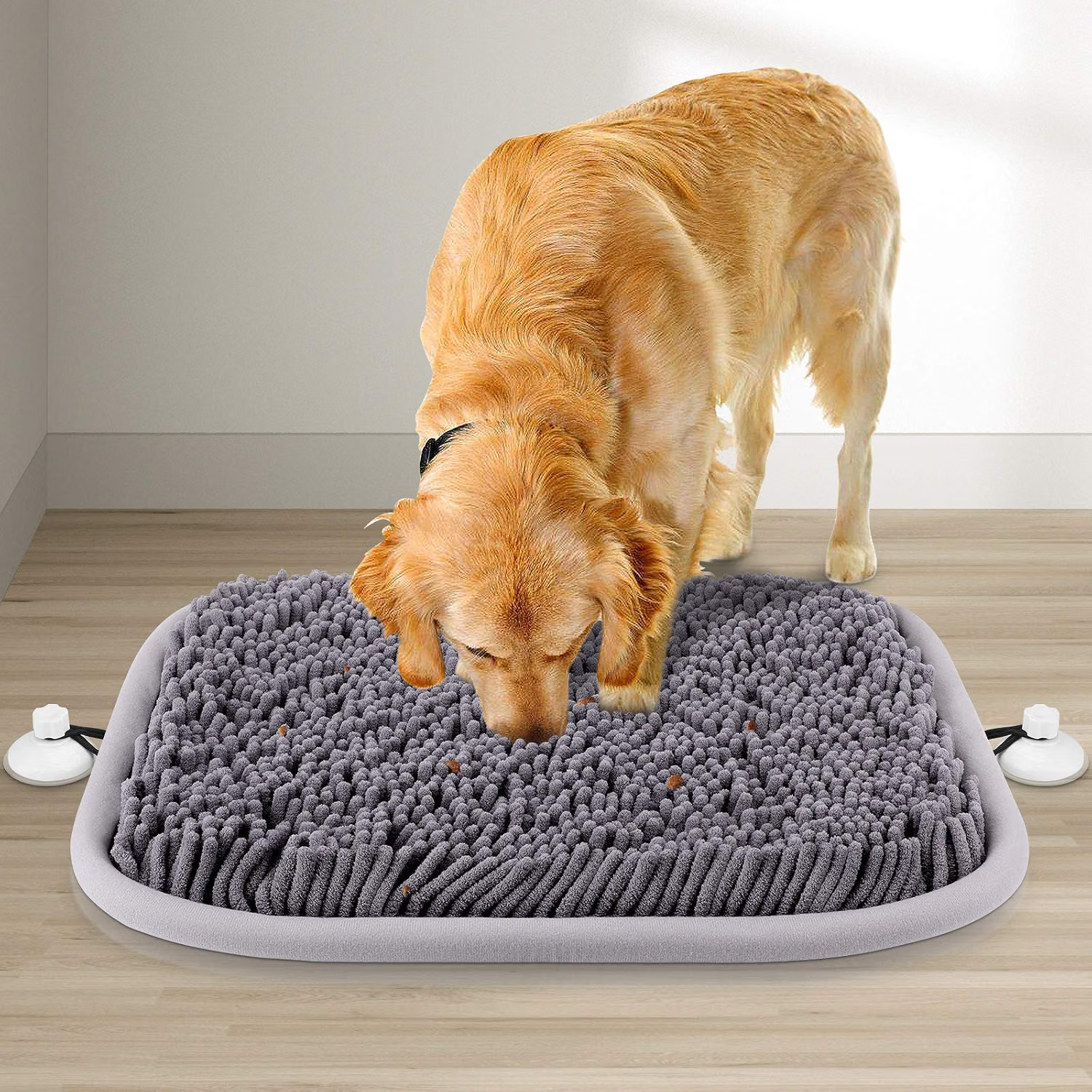
A snuffle mat can turn part of your dog’s normal mealtime or treat routine into a simple scent-based enrichment activity. Instead of eating everything in seconds, your dog has to use their nose and brain to find the food.
This can be especially useful for dogs that become restless when they’re bored. Mental enrichment gives them something constructive to focus on without requiring another high-energy play session.
Why we like it: It provides simple indoor enrichment and can help make your dog’s daily routine more interesting.
Pros:
- Provides scent-based mental stimulation
- Easy to use indoors
- Can make mealtime more engaging
- Useful for dogs that enjoy searching for food
Cons:
- Requires cleaning
- Some dogs may try to chew the mat
- Should be supervised when first introduced
Typical Price: $27.99
Affiliate Disclosure: This section may contain affiliate links. If you purchase through one of our links, TheDoggoLife may earn a commission at no additional cost to you.
8. Make Your Home Dog-Friendly Without Giving Up Your Style
Creating a calm home doesn’t mean your house needs to look like a dog daycare.
You can make practical changes while keeping your home comfortable for people too.
For example, instead of scattering dog beds throughout the house, choose one or two strategic locations.
Instead of leaving every toy on the floor, keep most toys stored away and rotate them.
Use washable blankets on furniture your dog regularly uses.
Place gates where they are actually needed rather than blocking entire sections of the house.
Choose furniture fabrics and flooring that can handle everyday dog life.
The goal is to create a home that works for both you and your dog.
That matters because a frustrated owner can unintentionally create a more stressful environment.
If your dog is constantly damaging furniture, slipping on floors, or getting into areas they shouldn’t, making the environment more dog-friendly can reduce problems before they start.
Related reading: [How to Make Your Furniture Dog-Friendly Without Ruining It]
9. Calm Home vs. Overstimulating Home
Sometimes the easiest way to understand the goal is to compare the two environments.
| Calmer Home | Overstimulating Home |
|---|---|
| Dedicated resting area | No consistent place to rest |
| Predictable routine | Constantly changing schedule |
| Regular exercise | Long periods of inactivity |
| Mental enrichment | Little to do |
| Quiet retreat available | No escape from activity |
| Comfortable bedding | Poor or inconvenient sleeping area |
| Managed outside triggers | Constant window watching |
| Clear boundaries | Dog constantly corrected |
A calm home isn’t necessarily a quiet home.
It’s a home where the dog has some control over how much stimulation they experience.
That’s an important distinction.
10. What Should You Change First?
If your dog isn’t relaxing at home, don’t try to change everything at once.
Start with the biggest problem.
Choose a better resting area if…
Your dog constantly moves around looking for somewhere comfortable to lie down.
Create a safe retreat if…
Your dog becomes overwhelmed when visitors, children, or other pets are around.
Add mental enrichment if…
Your dog seems bored and constantly looks for trouble.
Reduce visual or noise triggers if…
Your dog barks or reacts to everything happening outside.
Establish a routine if…
Your dog’s day is unpredictable and they struggle to settle.
Improve comfort if…
Your dog avoids their current bed or frequently changes positions while resting.
The best solution is usually the one that addresses the actual reason your dog isn’t settling.
11. Real-Life Scenarios
If You Have a Puppy
Puppies need plenty of activity, but they also need a lot of sleep.
Create a quiet resting area and don’t assume that every burst of excitement means the puppy needs more exercise.
Sometimes an overtired puppy needs help settling down.
If You Have a High-Energy Dog
Start with exercise and mental stimulation.
A puzzle toy or short training session can be just as valuable as physical exercise when you’re trying to create a calmer evening.
If You Have an Anxious Dog
Focus heavily on predictability and creating a retreat.
Don’t force your dog to interact with visitors or remain in situations that clearly overwhelm them.
If anxiety is severe or persistent, involve your veterinarian or a qualified behavior professional.
If You Have Multiple Dogs
Give each dog opportunities to rest separately.
Even dogs that normally get along may need individual downtime.
Multiple beds and separate resources can help prevent competition.
If Your Dog Spends Time Home Alone
Before leaving, make sure your dog has access to a safe, comfortable area and appropriate enrichment.
A camera can also help you understand what actually happens after you leave instead of guessing.
12. Mistakes to Avoid
Making the entire house silent
Your dog still needs to experience normal household sounds.
The goal is manageable stimulation, not complete isolation.
Constantly moving your dog’s bed
Dogs often appreciate consistency.
Once you’ve found a good location, give your dog time to become comfortable with it.
Using the safe space as punishment
This can destroy the positive association you’re trying to build.
Buying calming products before addressing the environment
A new product can’t compensate for a dog that isn’t getting enough exercise, enrichment, sleep, or predictable structure.
Overstimulating your dog
More toys, more activities, and more interaction aren’t automatically better.
Dogs need downtime too.
Ignoring sudden behavioral changes
If your normally relaxed dog suddenly becomes restless, withdrawn, destructive, or unusually vocal, don’t automatically assume the environment is the problem.
Behavior changes can have many causes and deserve appropriate attention.
13. Tips for Maintaining a Calm Home
Once you’ve created a better environment, consistency matters.
Try these simple habits:
Keep your dog’s resting area clean.
Wash bedding regularly and remove damaged items.
Rotate enrichment toys.
You don’t need every toy available every day.
Protect downtime.
Don’t constantly interrupt your dog when they’re sleeping or resting.
Keep routines reasonably consistent.
Meals, walks, play, and bedtime don’t need to happen at exactly the same minute, but predictable patterns help.
Watch your dog’s behavior.
Your dog will often show you what is working.
If they voluntarily spend time in their resting area, that’s a good sign.
Make adjustments gradually.
If you change the entire environment overnight, you may not know which change helped.
14. Frequently Asked Questions
What is the best way to help a dog relax at home?
Start with the basics: a comfortable resting area, predictable routine, appropriate exercise, mental enrichment, and a quiet place where your dog can retreat when they need downtime.
Should my dog have a designated calm space?
Yes. A dedicated bed, crate, mat, or quiet corner gives your dog a consistent place to relax. It doesn’t need to be an entire room.
Does background noise help dogs relax?
It can help some dogs by masking unpredictable sounds from outside or the household. However, every dog is different, so watch how your dog responds.
How do I know if my dog is overstimulated?
Pacing, excessive barking, inability to settle, constant attention-seeking, destructive behavior, or difficulty resting can sometimes indicate that your dog needs a better balance of activity and downtime.
Can calming products make my dog less stressed?
Some products may make a dog’s environment more comfortable or provide useful enrichment, but they shouldn’t replace exercise, training, appropriate rest, and addressing environmental triggers.
15. Final Recommendation
You don’t need to completely redesign your home to make it a calmer, happier place for your dog.
Start by looking at the environment from your dog’s perspective.
Where does your dog naturally choose to rest?
What noises or activities cause them to react?
Do they have somewhere to escape when the house gets busy?
Are they getting enough physical and mental activity?
Does their daily routine give them predictable periods of activity and rest?
Start there.
If you’re unsure where to begin, create one comfortable, quiet resting area and establish a more predictable daily routine. Those two changes can provide a foundation for everything else.
Then build from there with better enrichment, appropriate exercise, environmental adjustments, and dog-friendly furniture or products where they actually solve a problem.
The goal isn’t to create a perfect house.
It’s to create a home where your dog can comfortably be part of the family and know they have somewhere peaceful to go when they need to switch off.
Leave a Reply